Sunday, March 2, 2008

more pics from the trip to Buea

I'm sitting outside on a porch at CTC, across the road from home, where we come to use the internet.  I'm watching a rainshower and sending email. It's beautiful here.  It's Sunday, so it's very quiet.

Here is my final round of pictures from our trip to Buea and environs, in southwest Cameroon, a couple of weeks ago.  It was a work trip, and we met several clients of the microloan program we work with at RELUFA.  Ann is writing up articles about some of the people we met, for publication in the Presbyterian Church's Joining Hands newsletter.  We'll share those here when they're completed.  Ann is also planning to put up a blog post about the race up Mount Cameroon.  We were in Buea during the race, and saw part of it.


These are some of the spices used in the food we ate.  The two on the top were new to us.  They are savory and delicious, and I'm not sure what to compare them to.  They are key ingredients in the delicious pepper soup we tried for the first time in Beua.  On the bottom is garlic and black pepper on the branch.


Meg, our Bueua contact is on the left.  She is introducing us to a lady who is a client of CHAMEG, Meg's organization.  She's making food from cassava, or possibly cocoyams, with a big mortar and pestle.  Women prepare all the food here, traditionally, and it takes an awful lot of work.  


These are cocoyams.  They have no actual cocoa in them, and are not chocolatey.  They are a root vegetable.


Ann, Charlie, Meg and myself.  Charlie, who we met only briefly when he stopped by to see Meg, works with another NGO.


Meg in her office at CHAMEG.


Meg knows everyone in Bueua.  This guy is Christopher.  He's a journalist who heard we were coming and wanted to talk with Ann about why we were there and the articles she is writing.


Us, in Meg's office.  


Rose and Meg.  Rose works at the restaurant CHAMEG runs as part of its development work.


Ann interviews Rose.


Me and Meg in front of the CHAMEG office.
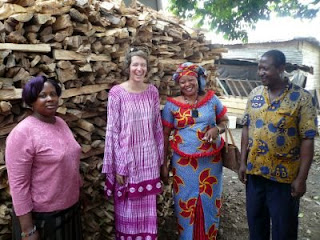

The lady on the left is also named Meg, and she is a loan client.  She operates a business selling firewood.  The man on the right is her husband Joseph, who runs a construction supply business.  Meg buys firewood by the truckload and sells it in smaller bundles to people in the neighborhood.  She sells two kinds, rubber wood (that stack in the picture) and mangrove.  Mangrove is more expensive, harder, much heavier, and burns longer.


Meg also makes and sells the small breadsticks that are popular here.  That's some of her stock on th eleft.  The blue device is the bag sealer she uses, and the silver utensil that she's holding she uses to form the dough.  She explained to us that she bought a German one awhile ago 
that works well, but a Chinese one she bought recently has broken down already.


Ann interviews Meg.

Ann and Emma, another loan client.  Emma operates a sewing business.  She travels to other African countries and the United States occasionally to sell her stock, and also makes clothing to order, for individuals and also for weddings.  People like to have special clothing made for weddings here; Emma told us about one wedding she sewed a hundred dresses for.


Emma, her assistant, and Ann.  The embroidery machine the assistant is working at is what Emma bought with her loan.


Serah and Sam, loan clients who opened a restaurant.  

The menu from Serah and Sam's restaurant.  We ate there a couple of times.  It was our first taste of Cameroonian pepper soup, one of our favorite dishes.  We plan to learn how to make our own.


Ann interviews Serah and Sam inside the restaurant.  They refurbished the building before they opened, knocking down the wall between the two dining rooms, painting, hanging decorations and curtains, providing furniture, building out the kitchen with a chest freezer from the US and a small gas range, and cleaning everything top to bottom.  The landlord told them they had raised the value of the property considerably, since it was a nondescript dusty concrete house when they started.
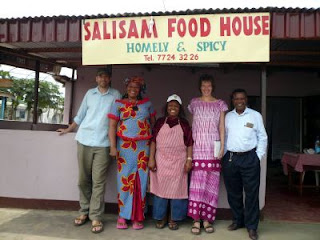


Me, Meg, Serah, Ann and Sam in front of the restaurant.  Homely = home-cooked, according to Sam.  Spicy we can vouch for.  They are working to build up their clientele; their idea for the restaurant was to provide affordable meals for students at the university in Bueua, who often live in rooms without kitchens and have trouble finding food.  They said they're starting to see regular customers, not just students but government and military people too.  The couple of times we were there, we always saw other customers.  But they said they haven't turned a profit yet.


The beach town of Limbe.  It's not too far from Bueua, so Meg brought us down here to show it to us.  We sat at a cafe for a little while and looked at the Atlantic in the late afternoon.  Here, Ann realizes she just got her feet all wet.


At the cafe in Limbe with Meg.


A boat in Limbe.  


Meg negotiates.  It was fun to watch someone do this who was obviously an expert; we always feel a little lost when we buy things.


Meg took us to the botanical garden in Limbe.


There were lots of towering trees in the garden, which covers several acres.  The little pink blur at the base of the tree is Ann and Meg, to give some idea of scale.  And we saw several trees that were taller than this one.


Meg and Ann in the garden.


Ann in the garden.


One of the trees in the garden.


Ann snapped this out of our bus on the way home.  The toll gates on the highway have lots of vendors who sell food to passing travellers.  People buy and sell through the windows, and the driver seems to keep an eye on things to avoid taking off again until people are finished.  Coconuts, bananas, oranges, manioc, fresh water in plastic sachets, tissues, and all sorts of other things are available.  But never anything in a bottle, for some reason, either alcoholic or otherwise.  

Friday, February 29, 2008

another quiet day

It's about 3pm on Friday afternoon. It's another quiet day here for us,
and we walked up to CTC here to use the internet about an hour ago.
Taxis are running again, and we hear from our friends that things are
getting back to normal. The US embassy is suggesting people leave the
country if they can, but what we hear from friends on the ground here is
that it looks like things are settling down, so perhaps the embassy errs
on the side of caution. If the calm continues through the weekend,
we'll head back into work on Monday, which we reach on the other side of
town via taxi. We've spent this week working from home and visiting
with neighbors. Julia, the Cameroonian lady we employ to do
housekeeping (this arrangement came with the house, and she's very nice)
managed to get in today, since the taxis are running.

Thursday, February 28, 2008

quiet day

It's been a quiet day for us. It's a few minutes after 3pm. It's raining a bit here, because the rainy season is due soon. The strike obviously continues because there are still no taxis on the street. There are more advisories from the missionary community and the embassy not to leave home, to have food in the house, to pack a travel bag, and the embassy suggests short-term visitors leave when possible. We saw a couple of guys in camos with guns standing around by the road when we walked across the road here to CTC; you see guys like this out checking papers at night, but not usually during the day. No real news from the neighbors, and no phone calls from our RELUFA friends to warn us about any new developments, so maybe things are quieting down.

Wednesday, February 27, 2008

Lockdown

Things in our immediate neighborhood are still quiet, but the city of Yaounde has heated up considerably today. We hear that there is unrest in different areas, some cars have been burned, some people have been killed, the military was called out to disperse a crowd of a hundred thousand protesters downtown. We're up at CTC again, just across the road from where we live (we were told that this brief walk in the neighorhood was safe). We're on a Younde email list for the missionary community, and today's email traffic is a combination of the usual news about comings and goings, combined with notices about this or that person pinned down in this or that area by the unrest and unable to travel and waiting it out somewhere. There is a message about a mob on the street up the road a couple of miles, another about lockdown, requesting that people stay put for the time being. We have also had phone calls from Valery and Christi today, making sure we know not to travel, and suggesting we stay at home with the doors locked. It's nice to be at CTC, since it was safe to walk up here, around lots of other people, getting the news and checking email.

Here's the "Warden Message" from the embassy today. ...Hang on, there's a note at the bottom of it saying that these things are not supposed to be copied. I'll have to take that other one off the blog. Basically, it says that there is looting and unrest downtown and in some other areas of Yaounde, and Americans should not travel. And it suggests to make sure you have supplies for a week, review your travel documents, consider packing an emergency bag, and avoid public gatherings.


Things are calm here at CTC, and at the moment Ann is chatting with a young missionary here in the computer room just behind me. There is no sense of panic, and people are finding places to stay at night if they live across town.

Here is the very brief Reuters story on the situation from about an hour ago, courtesy of Google News:


Rioting spreads to Cameroon capital Yaounde

Wed 27 Feb 2008, 12:35 GMT

YAOUNDE, Feb 27 (Reuters) - Stone-throwing youths set up burning barricades and clashed with police in Cameroon's capital Yaounde on Wednesday as the city was gripped by anti-government protests that have raged for four days in the west.

Witnesses said shops closed and traffic disappeared from the streets as groups of protesters, who shouted slogans against President Paul Biya and complained about the high cost of living, blocked roads in the city centre and other districts.

Tuesday, February 26, 2008

Strike

I have mixed feelings about sharing the following.  So let me preface it by saying

We're fine.  Our friends are fine.  Everyone we know is fine.  And things are very quiet where we live.  

So --

There is a taxi strike going on in Yaounde.  We can't get to work.  There is also a taxi strike in the bigger port city of Doula as well, and that one has turned into some general unrest that has included some violence.  

Here's today's "warden message" from the embassy here in Yaounde:

(deleted, basically says not to travel between cities, mentioned trouble in Douala)

I'm currently at the CTC complex near our home; we live near lots of people who work for a mission organization called SIL.  We got an account to have net access here; there is housing and a school here, and some administrative offices.  The street was quiet when I walked here, since more than half the traffic on a normal day is taxis, and there are no taxis today.

Here's a story about what's going on in Douala.  This is a bit grim, so let me repeat that we have seen nothing like this here in our area, or heard about any such thing here in Yaounde.  To put this in perspective, the country to the north is Chad, where there was recently a big armed rebellion; SIL simply evacuated its people (many who have little kids) in an orderly fashion.  We have met several.  They're living in the neighborhood, lunching at the CTC canteen, and waiting to go back to Chad.  Unrest and even evacuation is something that just happens to ex-pats who live over here from time to time; nobody likes it, but people roll with it and keep on with their work and lives.  And things here are nowhere near that point.  

From Reuters AlertNet:

CAMEROON: Douala burns as taxi strike turns into general rioting
25 Feb 2008 15:14:39 GMT
Source: IRIN
Reuters and AlertNet are not responsible for the content of this article or for any external internet sites. The views expressed are the author's alone.
DOUALA, 25 February 2008 (IRIN) - - Residents of Douala awoke to heavy gunfire on 25 February. Columns of thick black smoke rose over the city as youth burned buses, cars and tires, blocking off major arteries in the city.

There are also reports of widespread of looting.

"We can't leave our homes," a man in Akwa, in the city centre, told IRIN. "I live near a school and can see teachers sending home all students that arrive."

"Rioters are occupying other schools in the area," he said.

At least two dead bodies have arrived at the city morgue with gunshot wounds to the head, a journalist told IRIN.

IRIN also saw people with serious gunshot wounds being carried to a hospital.

The rioting appears to have been sparked off by a taxi strike planned for 25 February. Many people say they are in sympathy with drivers' complaints of rising fuel prices and the cost of living.

IRIN saw no vehicles in the city centre other than those filled with security forces.

Political tensions have been high in recent days with the government attempting to push through constitutional reforms that would remove restrictions on the number of terms that Cameroon's long time leader Paul Biya can be re-elected. He has been in power since 1982

An unauthorised demonstration took place on 23 February in Newtown, a suburb near the airport, at which police reportedly fired tear-gas and water cannons at a crowd of several hundred people. One protestor was killed, according to government officials but eye witnesses said at least one other youth also died.

The following day, Sunday, the city was calm until the evening when gunfire erupted again near the airport.

Then by Monday morning rioting broke out throughout the city.

Accounts of the violence

One of the main bridges to the city has been blocked by burning tires, according to an eyewitness living nearby. "We see smoke everywhere and hear constant gunfire," she said.

The national radio reported that many government buildings were on fire, including a town hall and one of the finance ministry buildings

The main road between Douala and the capital, Yaounde, is blocked by burning tires and IRIN saw a number of petrol stations being looted along that road.

Youth have also reportedly broken into at least one major retail store..

In the city centre IRIN saw large gangs of youths moving through the streets with no police around. But elsewhere police were seen arbitrarily arresting civilians.

"I saw two people in front of my office being stopped by the police and arrested for no reason," said human rights advocate Madeline Afite, of the Action by Christians for the Abolition of Torture.

People catching flights out of the city had to walk to the airport. IRIN saw youth attempt to enter the airport compound. Some appeared to be armed and shooting at the police. Police also appeared to be returning fire.

"I think what is happening is that youth saw recent events in Kenya and are now trying to copy," Mary Mballa, a mother in Newtown told IRIN.


If I Google "Yaounde strike" I see stories that the taxi strike in Yaounde was called off.  This is manifestly not the case; today is the second day of the strike here, and the usual river of yellow taxis in the road has dried up completely.

So we're fine.  But this is an unhappy part of life here for now, and unlike us, most Cameroonians are not free to leave at the end of a year and go somewhere stable and wealthy and leave it all behind.

I used to wonder whether the affluence of the US and weathly countries was somehow at the cost of other poorer countries.  I knew a lot of people believed this, but had never really seen a demonstration that satisfied me, and some of my smart, well-read American friends scoffed at the idea.  But if you talk to people here, smart people, educated people who follow world events and have lived here a long time, as well as to people with fewer opportunities in life, you find a lot of people saying that the political order here is decided far away in France, that the west provides arms and support for the political elites in Africa, in return for access to resources, and that the majority of the people play no role in decision-making, see no benefit from this arrangement or the resources of their country, and are left to eke out a living as best they can.

We've met a lot of people here, Cameroonian and American, NGO workers and missionaries, working hard to help people, but all the successes are on an individual, person-to-person level, or (in the case of the remarkable food-bank program at RELUFA), the family and village level.  But nobody has talked about successes on a larger scale in ameliorating the conditions that make life so hard for people here.  And nobody we've met, not one person, has voiced any hope that the lives of most Africans will improve in the future.  Nobody.

I'm new here, and I'm no expert, and I'm not staying very long.  And of course, any opportunities that people find on an individual level to improve their lives matter tremendously to them, to their families, and to the world in unknown ways.  This is simply what we've seen and heard and noticed, nothing more.  I am in no position to judge.  But what we've seen is not encouraging.  

Sunday, February 24, 2008

visit to Muyuka

After Kumba, we went to the nearby small town of Muyuka. We connected with Meg, our RELUFA contact for the trip, and drove in her truck to visit Michael and Agnes.  They founded and run an organization called Domec that provides help and training for orphans, widows and people living with HIV. Meg has known them for awhile, and they may be applying for a loan from the CAP program we work with, so we were there to meet them and get material so Ann can write an article.

Michael and Agnes started Domec on their own, and do a lot of work in different areas to help people out. Here are some pictures of their work, and of Domec's clients. Once again, we found ourselves received with kindness and hospitality. The adults were friendly, eager to explain their activities, and talk about the adversity their clients work to overcome. They kids were shy and quiet, and curiously followed us around everywhere on our tour. Everyone seemed happy to share their story. Ann's articles are for the Joining Hands newsletter, and/or the RELUFA website (see links in sidebar at right), and we will post them here as well.

I've tried again to share the faces of some of the people we've met, in spite of the small size of these images. So there are quite a few pictures this time.


Ann, Meg, and Meg's truck.  This was a pleasant change after the bus ride to Kumba.  The road between Buea and Kumba, where Muyuka lies, has not been fixed in 20 years, we heard.  It looks as though it's been shelled by artillery, and is unpaved and really dusty.


Domec's sign.


Domec teaches sewing.  Their program is three years long, and teaches several practical skills.  This is unusual here; we have been told that formal schooling basically prepares people for civil service jobs, of which none are available.

Ann and Michael.


The computer lab at Domec, where kids learn typing and computer usage.  That chalkboard describes what a mouse is and how to use it.  Seeing this in the US, I would have immediately asked myself why there are not more machines here.  I'm a programmer by trade, and I know how easy it is to find used computers in the US.  People in San Francisco actually dump them by the side of the road from time to time, just to get rid of them.  But that's not the problem.  The problem would be to get them here.  Muyuka is far up a bad and dusty road in a corner of Cameroon.  And first you'd have to get them into the country, which would be very expensive, for transport and then taxes.  And once they're here, the heat and especially the omnipresent dust in this part of the country would mean they wouldn't last very long.  


Domec does lots of agricultural training.  This is where they raise snails, which the residents eat for protein.  There is also a piggery, but the pigs all got sick and died, so it is empty for the moment.


Domec's tree nursery.  The plastic-covered frame contains saplings.


Michael explaining something on our tour.


The sign painted on the side of the boys' dormitory building.  


Ann sees her first growing pineapple.  It's the brown knob on the top of the plant she's staring at.

Michael explains how Domec trains the students in agricultural grafting techniques.  Citrus fruit is grown by grafting branches from an existing tree onto another plant, sometimes a different kind, itself grown from a cutting.  This particular tree, Michael is explaining, will produce both lemons and oranges.  They also grow grapefruit, and gave us some to take with us.  Like the pineapple in Cameroon, the grapefruit is not acidic, but mild and sweet.


Domec's yam cultivation project.  This is a bed of damp woodchips in a shed.  They purchase yams, then cut them into small pieces and put them in the woodchip bed.  These pieces develop into full-grown yams, which can then be sold at a profit.


A group photo out front, before we left.  The top row, from left, is Meg (our RELUFA contact), Agnes (who started Domec with Michael), four clients, and Michael.  The kids in front of Ann are all students.  The little one in pink trailed around with Agnes the entire visit, so we assumed she was a family member.


Ann and a lady who is living with HIV and runs the program there for women in her situation.  She has several children, who also live there.  We saw pictures of how she looked a year ago, ill and emaciated.  She has made a wonderful recovery since then and is in good health.  


Michael and me.


Students.


The lady who runs the program for women with HIV.


Michael again.


Micahel's wife Agnes, cofounder of Domec.  She insisted we have some drinks before we left, and that we take a bag of their grapefruit with us. 


Agnes's companion throughout our tour.


Some of the ladies look on as Ann gets an explanation of where pineapples come from.


Some of the kids whose mothers are in the women's program.  Many of these children, says Ann (who worked with HIV clients in the Bay Area for years), are probably themselves positive.


More kids with mothers in the women's program.


Students trying not to laugh.  I sternly insisted that everyone be serious for the picture, to try to make them smile.

Some of the ladies from the women's program.


Michael and Meg.  Meg's organization in Buea, called CHAMEG, is a RELUFA member NGO.  Except for the trip to Kumba, we went almost everywhere with Meg, although she left us alone for interviews with loan clients so that people wouldn't feel pressured.  She took good care of us.